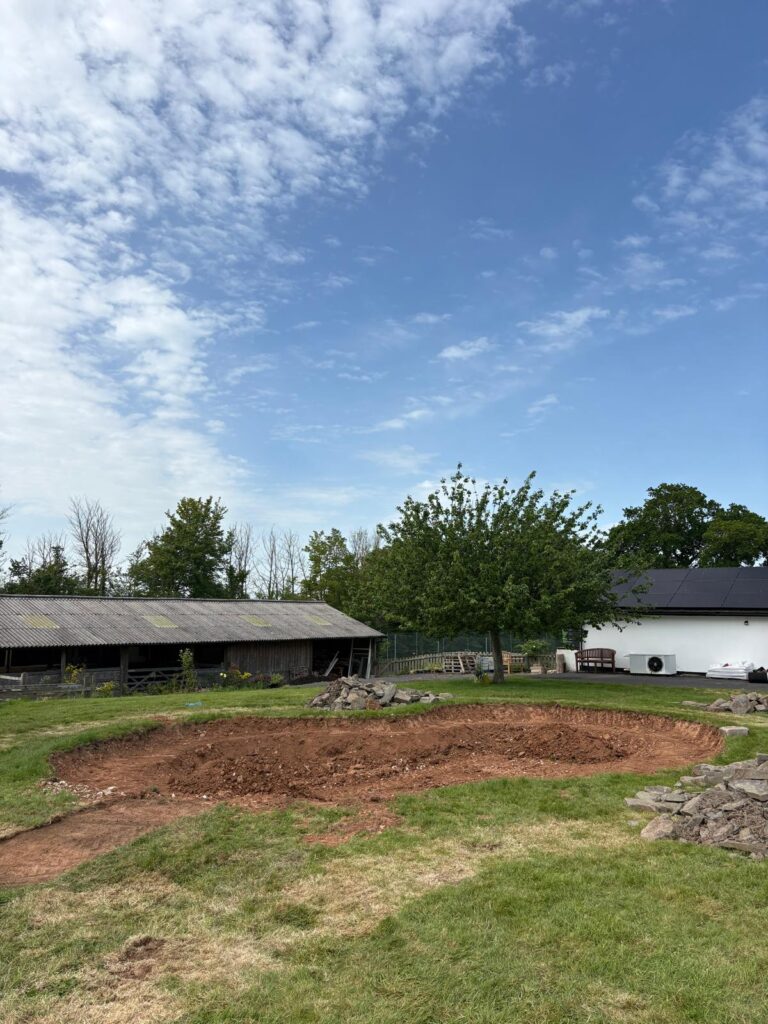
Can You Build a Wildlife Pond on Sloping Ground? Levels, Banks and Spoil Explained
Yes, a wildlife pond can be built on sloping ground—but the slope changes almost every practical part of the job. The finished water surface will always be level. If the surrounding land is not, the design has to reconcile the uphill and downhill sides without leaving an exposed liner edge, an unstable bank or a pond that looks perched above the landscape.
On many sites in Devon and Cornwall, a slope is not a reason to abandon the idea. It is a reason to set the levels properly before excavation starts. The difference between a pond that settles naturally into the site and one that needs repeated correction is usually decided at this stage.
The waterline is level even when the land is not
Water finds its own level. That sounds obvious, but it is the central issue when a pond is built across a slope.
Imagine marking a level line around the proposed pond. On the uphill side, that line may sit below the existing ground, so material needs to be cut away. On the downhill side, the same line may sit above the ground, so the pond edge and surrounding landscape need to be built up or the whole pond moved farther into the slope.
If this difference is not understood before digging, common problems include:
- an uphill bank that becomes unnecessarily deep or steep;
- a downhill edge made from loose, unsupported fill;
- liner showing as the ground settles;
- surface runoff entering from the high side;
- too much excavated material with nowhere sensible to use it; and
- a finished pond that looks raised at one end and buried at the other.
A simple site level survey can prevent much of this. For more involved sites, our pond design service connects the proposed water level with the ground profile, access, water source, overflow and finished landscaping.
Start with the proposed water level, not the hole
The first useful decision is the intended normal water level. From there, the pond footprint, excavation depths and edge treatment can be worked out against the actual ground.
We normally consider:
- the height difference across the footprint;
- where the pond can be cut into firm natural ground;
- whether the lower side needs reshaping, retaining or a change in footprint;
- how much freeboard is needed above normal water level;
- where rainfall and groundwater currently travel;
- how the overflow will leave safely; and
- how machinery, liner, stone, plants and other materials will reach the area.
For a modest garden pond, this may be a straightforward laser-level exercise. A larger pond, high embankment or difficult ground may require more detailed design and specialist input.
Cut-and-fill: useful, but only when it is controlled
On a slope, the usual aim is to balance excavation and landscaping rather than simply dig the whole pond to the deepest point. Material removed from the uphill side can sometimes help reshape the lower surroundings, create gentle external grades or form wider habitat areas.
That does not mean tipping loose spoil against the downhill liner edge and treating it as a finished bank. Fill can settle, wash out or move under load. The lower side needs to be formed from suitable material, placed and compacted in a controlled way, or redesigned so the critical pond edge remains supported by firm ground.
The safest solution is often to move the pond slightly into the slope, reduce unnecessary depth or adjust the shape so less of the water-retaining edge depends on built ground.
What happens to the excavated soil?
Excavated soil is a design issue, not an afterthought. Even a moderate pond can produce much more material than the surface outline suggests.
Before work starts, it helps to separate the likely materials:
- Topsoil can often be retained for final landscaping, planting areas and reinstatement.
- Suitable subsoil may be useful for controlled grading or habitat shaping.
- Stone may be reusable in some landscapes, depending on its condition and the intended finish.
- Unsuitable, contaminated or mixed material needs a defined handling or disposal route.
On-site reuse is often practical and economical, but only where it improves the finished site. A large mound placed wherever the dumper can reach is not a spoil plan. Material should not block drainage routes, bury valuable grassland, damage tree roots or be spread so thinly that poor subsoil replaces the existing surface.
This is one reason our pond construction cost guide treats excavation volume and spoil handling as major cost drivers rather than minor details.
The downhill bank needs particular attention
The lower edge is where poor setting-out tends to show first. It carries the visual transition between the level water and falling ground, and it may also be the point most vulnerable to settlement or overtopping.
Depending on the site, practical options can include:
- moving the pond farther uphill;
- reducing the width or depth;
- using a longer, gentler external grade;
- forming a properly designed and compacted bank;
- using suitable stone or structural work where justified; or
- splitting the idea into smaller linked ponds, scrapes or wetland cells.
The right option depends on scale, soil, water-retention method and what lies downhill. A small decorative retaining edge is not the same as a bank holding back a substantial depth of water.
Shallow margins still matter
A sloping site can tempt people into creating a deep bowl with narrow steps around it. That may reduce excavation width, but it usually produces less useful habitat and awkward planting shelves.
Wildlife ponds benefit from broad, shallow, varied margins. Freshwater Habitats Trust’s pond design guidance recommends very shallow, undulating margins and notes that gradients around 1:20 can create broad drawdown zones where space allows.
That does not mean the whole pond must follow one uniform gradient. A good design can combine:
- a shallow beach or drawdown area;
- low shelves for marginal planting;
- deeper water where appropriate;
- irregular edges and protected refuge areas; and
- an accessible point for future maintenance.
On a slope, these zones need to be set from the water level. Measuring every shelf from the existing ground will produce inconsistent water depths.
Liner edges and protection on a slope
For an EPDM-lined pond, the liner has to reach above the maximum intended water level around the entire perimeter. On sloping ground, the downhill edge may need considerably more landscape build-up than the uphill edge before the liner can be hidden securely.
The liner also needs suitable support and protection. Sharp stone, unstable fill and later settlement can all create problems. If stone or gravel is being used to finish the edge, its weight and likely movement need considering rather than simply placing it on the liner.
Clay, bentonite and geosynthetic clay liner systems have different ground-preparation and confinement requirements. A water-retention method that works on one site may be unsuitable on another, especially where the lower bank is made ground or groundwater pressure is involved.
Do not let the slope turn the pond into a silt trap
The high side of the pond naturally receives water moving downhill. Directing all of it into the pond may seem useful, but runoff can carry soil, nutrients, road residue or material from yards and tracks.
The first job is to understand the source. Our guide to springs, seepage and surface runoff explains the clues we look for before deciding how water should interact with a new pond.
Depending on the catchment, the design may need:
- a clean-water route into the pond;
- a swale or vegetated buffer;
- an accessible sediment trap;
- a separate seasonal scrape; or
- an offline pond that is protected from the main runoff route.
The overflow is just as important. It needs to operate before water reaches the liner edge or unstable fill, and it must discharge somewhere that will not create erosion, flooding or a problem for neighbouring land.
Access can decide whether the project is viable
A sloping site may look accessible on foot but behave very differently under machinery. Excavators and dumpers need a safe route, working area and suitable ground. Repeatedly moving material uphill or through a narrow garden can add more time than the pond excavation itself.
Before pricing, we need to know:
- gate and passage widths;
- changes in level and tight turns;
- soft ground, retaining walls and weak surfaces;
- overhead and underground services;
- where materials can be delivered; and
- where excavated soil can be placed or loaded out.
The Health and Safety Executive’s guidance on underground services applies to planning and carrying out excavation work near buried utilities. Service plans and locating equipment are useful, but they are not a reason to assume every cable or pipe has been mapped accurately.
Common mistakes on sloping pond sites
- Choosing the outline before checking levels. The attractive shape on the lawn may create an impractical height difference across the pond.
- Making the low side from loose spoil. Settlement can expose liner edges and distort the bank.
- Digging too deep to “make it level”. This can create a steep uphill face and far more spoil than expected.
- Building narrow wildlife shelves. Thin ledges are difficult to finish and provide less useful shallow habitat.
- Ignoring runoff from above. The pond may become the first collection point for sediment and nutrients.
- Leaving the overflow until last. The safest outlet should influence the level and position from the start.
- Assuming all spoil is useful. Topsoil, subsoil, stone and unsuitable material need different treatment.
- Forgetting the finished landscape. A technically watertight pond can still look awkward if the banks do not meet the surrounding ground naturally.
Would a different water feature suit the slope better?
Sometimes one conventional pond is not the strongest answer. A series of shallow cells, a wetland terrace, a scrape at the foot of the slope or a smaller pond connected to surrounding habitat may achieve more with less retaining work.
For larger rural sites, our landowner pond service considers the whole field, catchment and machinery route. For gardens, our wildlife pond construction service focuses on fitting the water into the existing landscape and access.
Planning and environmental requirements depend on the site and the work proposed. Significant changes in levels, work near a watercourse, protected habitat, boundaries or other constraints should be checked before construction. Our guide to pond planning and environmental checks explains the main triggers.
Planning a pond on sloping ground in Devon or Cornwall?
Send photographs taken across the slope as well as towards it, approximate dimensions, access widths and any known service information. It is also useful to say whether excavated soil can remain on site and what you want the wider area to become.
Tell us about your wildlife pond project. We will review the information and explain whether the site looks suitable for an initial discussion, site assessment or design stage.