Ghost Ponds: Bringing Lost Farm Ponds Back to Life
Some ponds disappear without disappearing completely. A field may contain a damp hollow, an unusual circular crop mark or a depression that appears on an old map but no longer holds open water. Beneath the surface, the sediments of the former pond can sometimes remain.
These lost waterbodies are often called ghost ponds: historic ponds that were deliberately filled in, particularly as farmland was reorganised and intensified, but which can still leave physical and ecological traces in the landscape.
For landowners considering pond creation or wider habitat restoration in Devon and Cornwall, an old pond site can be worth investigating before simply choosing a completely new location. In the right circumstances, restoring a former pond can reconnect a piece of the landscape’s ecological history as well as creating useful freshwater habitat.
What is a ghost pond?
The term has been developed through research led by the UCL Pond Restoration Research Group. It describes ponds that were filled in and converted back to land, often during agricultural land consolidation.
They are not always invisible. Researchers describe former pond sites surviving as damp depressions, changes in vegetation or crop growth, or other subtle marks in a field. Historic maps can also reveal ponds that have disappeared from the modern landscape.
That makes ghost ponds different from simply digging a new pond where a field happens to be wet. The starting point is evidence that a pond was actually present before.
Why can restoring an old pond be so interesting for wildlife?
The most remarkable part of ghost-pond research is what can remain buried below the topsoil.
A 2017 study published in Biological Conservation found viable propagules from at least eight aquatic plant species in sediments from ponds that had been buried for around 50 to 150 years. Re-excavated ghost ponds in the study also developed diverse aquatic vegetation rapidly, with recolonisation recorded within six months.
That does not mean every filled-in pond contains a perfectly preserved seed bank, or that a pond in Devon will respond exactly like the study sites in Norfolk. But it shows why the old pond sediments can be valuable and why blindly excavating through them would miss part of the opportunity.
Ghost ponds are part of a bigger pond landscape
A pond is more useful when considered as part of the surrounding landscape rather than as an isolated hole full of water.
Research and guidance from UCL and the Freshwater Habitats Trust emphasise the value of having a mixture of ponds: old and new, shallow and deeper, permanent and seasonal, open and more vegetated.
For a farm or estate, that can mean looking beyond a single proposed pond and asking:
- where historic ponds were located;
- which existing ponds remain in good condition;
- whether some old ponds have become heavily shaded or silted;
- where clean water is available;
- how ponds connect with hedges, rough grassland, woodland and wet areas; and
- whether a restored ghost pond would strengthen that wider habitat network.
Sometimes resurrecting an old pond will make sense. On another site, protecting an existing seasonal wetland or creating a new clean-water pond may produce a better result.
How do you find a ghost pond?
There is rarely one piece of evidence that proves a lost pond exists. It is normally a case of combining several clues.
1. Historic maps
Old Ordnance Survey and estate mapping can show small ponds that have vanished from current mapping. Comparing historic and modern plans is one of the most useful first checks.
2. Depressions and wet patches
An infilled pond can settle differently from the surrounding ground, leaving a shallow hollow. Some locations remain wetter than the surrounding field because the original basin and sediments still influence drainage.
3. Crop and vegetation marks
Changes in soil moisture and buried material can affect how grass or crops grow, producing a visible outline at certain times of year.
4. Local knowledge
Landowners, previous occupiers and neighbours may remember a pond being filled or know why a particular part of a field has always behaved differently.
No single clue should automatically trigger excavation. The evidence should be considered alongside the site’s soils, hydrology, current habitat and land use.
Restoration is not simply ‘dig out the hollow’
If the aim is to recover a historic pond, excavation needs more care than creating a completely new feature.
The former pond profile may be hidden beneath layers of later fill. Old pond sediments can appear as darker material below the newer topsoil. Those sediments may contain the propagule bank that makes the site particularly interesting, so the objective is not necessarily to remove everything until clean subsoil is reached.
The practical job can involve:
- confirming the likely historic footprint;
- understanding the source and quality of water;
- carefully removing later infill;
- identifying and retaining appropriate historic pond sediment;
- avoiding unnecessary deepening or over-engineering;
- creating useful shallow margins and drawdown areas where they fit the historic form;
- managing excavated spoil without burying neighbouring wet habitat; and
- protecting the pond from nutrient-rich runoff after restoration.
Clean water still matters
Bringing back the old shape of a pond does not automatically bring back a healthy pond.
If the site now receives fertiliser-rich field runoff, dirty yard water, road drainage or another pollution source, simply reopening the basin may create a nutrient-rich sediment trap rather than a high-quality wildlife pond.
Current pond conservation guidance repeatedly emphasises clean water. Before restoration, it is worth understanding the pond’s catchment and whether the source of water has changed since the historic pond existed.
On some sites, the best project may therefore include buffers, changes to drainage, small wetland features or a different water route rather than excavation alone.
When should an old pond be left alone?
Not every depression shown on an old map should be excavated.
A former pond may now support valuable terrestrial or seasonal wetland habitat. There may also be protected species, archaeology, buried services, drainage infrastructure or other constraints that need to be understood first.
This is particularly important because temporary and seasonal ponds are valuable habitats in their own right. A feature that dries naturally is not automatically a failed pond and should not necessarily be deepened to make it permanently wet.
Can ghost pond restoration receive grant funding?
Potentially. In England, the current specification for Capital Grants item WN12 explicitly includes restoring the wildlife value of ghost ponds, subject to its rules and a pre-application assessment for wildlife and historic interest.
The 2026 Capital Grants application window is currently closed, so this should not be treated as an invitation to start grant-funded work now. Future funding rounds and eligibility can change. The useful point is that historic pond restoration is recognised within agricultural environmental funding and is worth considering when future schemes or local funding opportunities open.
Ghost ponds in Devon and Cornwall
Most of the published UK ghost-pond research has focused on Norfolk, so it would be wrong to assume that every historic pond in the South West will contain the same buried seed bank or respond in the same way.
Devon and Cornwall do, however, contain many farms and estates with historic ponds, wet hollows and altered drainage systems. Where historic mapping and ground conditions suggest a genuine lost pond, investigation can form part of a wider habitat assessment.
For us, the useful question is not simply “Can we dig the old pond back out?” It is:
What was here, how does water move through the site now, what habitat already exists, and would restoring this particular pond improve the landscape?
How SAS Aquatics can help
SAS Aquatics works with landowners, farms, estates and organisations across Devon and Cornwall on wildlife pond creation and restoration, wetland and habitat projects and practical habitat creation proposals.
For a suspected ghost pond, we can help review the site, historic evidence, water source, access and likely construction approach before deciding whether restoration is sensible. Where a project needs ecology, archaeology or other specialist input, that should be identified before excavation rather than discovered halfway through the work.
If you have an old map showing a lost pond, or a persistent hollow or wet patch on your land that may once have been one, send us the location, photographs and any historic mapping you have.
Frequently asked questions
What is a ghost pond?
A ghost pond is a former pond that has been deliberately filled in but can still leave evidence in the landscape, such as a depression, crop mark or buried historic pond sediment.
Can plants really survive beneath a filled-in pond?
Sometimes. Research in Norfolk found viable seeds and other propagules from aquatic plants after roughly 50 to 150 years of burial. That is strong evidence for the potential of some ghost ponds, but it should not be assumed for every site.
How can I tell whether there used to be a pond in my field?
Historic maps are a good starting point. A persistent depression, wet patch, vegetation change and local knowledge can add supporting evidence.
Should a seasonal pond be dug deeper?
Not automatically. Seasonal ponds can be highly valuable wildlife habitats. The existing ecology and hydrology should be understood before changing the depth or water regime.
Is restoring a ghost pond better than digging a new wildlife pond?
It depends on the site. A ghost pond can reconnect historic habitat and may retain a buried seed bank, while a new pond may be better positioned to receive clean water or connect other habitats. At landscape scale, a varied network of ponds is usually more useful than treating one pond type as the answer everywhere.
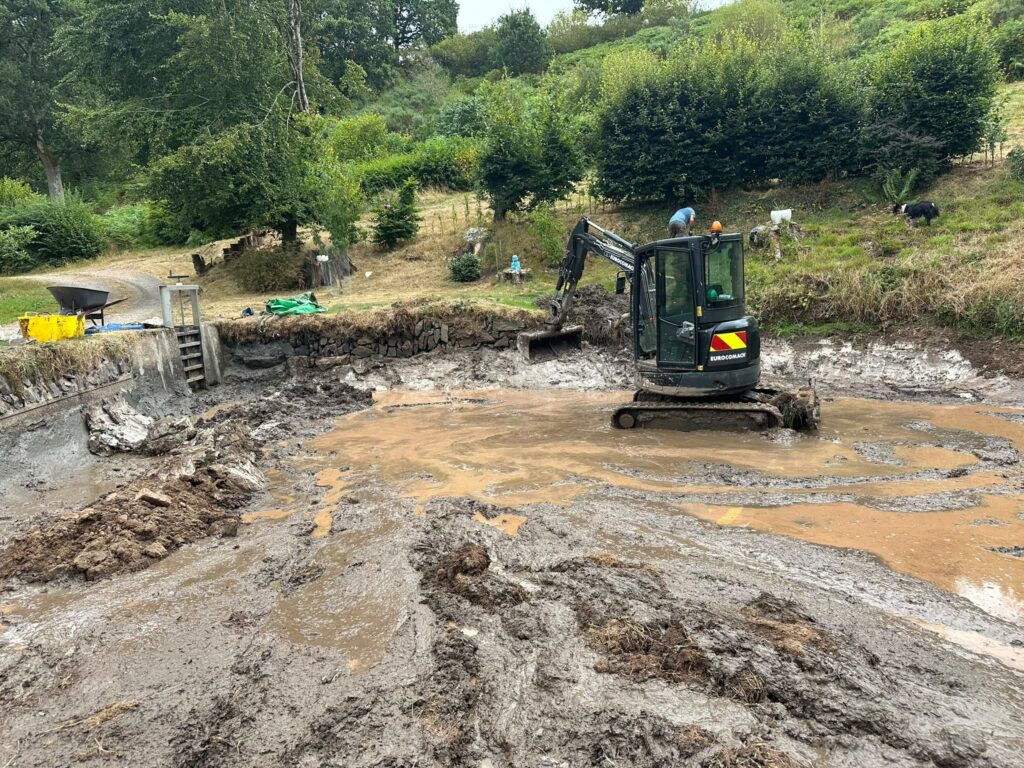
The featured photograph shows SAS Aquatics carrying out pond restoration work in North Devon. It is included as an example of practical pond restoration and is not presented as a documented ghost-pond resurrection.