Planning, Grants & Environmental Support
Planning, grants & environmental support · Devon & Cornwall
Make the project clear before you commit
Practical site assessment, supporting documents and habitat proposals for ponds, lakes, wetlands and wider land-management projects.
Evidence that leads to a buildable next stepWe connect the project aim with the realities of water, ground, access, construction and future care.
Start with the decision
Useful information, shaped around what the project needs to prove
Whether you are testing feasibility, supporting a funding application or turning an environmental objective into a practical scheme, we help define the work clearly before money and momentum are committed.
The aim is not to produce paperwork for its own sake. It is to answer the right questions, expose practical risks and give clients, advisers and funders a credible route forward.
A paid professional first step
Start with the level of assessment the decision deserves
We review the information first, then confirm the visit scope and fee before anything is booked. This keeps a straightforward site discussion separate from work that needs written evidence or a technical brief.
Fees depend on location, travel, site scale, available information and the output required. The agreed scope and price are confirmed in writing before the visit. Follow-on credit: £250 + VAT is credited to the first works invoice when SAS Aquatics is commissioned within six months for qualifying construction or major refurbishment of £10,000 + VAT or more. Written reports, specialist work and travel supplements are excluded; eligibility is confirmed before the visit.
Three support routes
Choose the question the project needs answered
Some projects need one focused piece of work. Others combine site assessment, habitat proposals, costs and supporting information into a wider brief.
Hydrology reports & water-management assessments
Site-led review of water sources, movement, retention, levels and practical constraints, with the implications explained for the proposed pond, lake or wetland work.
View hydrology support →Grant-supporting documents
Clear scope, intended outcomes, methods, costs and supporting site information that can strengthen an environmental or habitat funding application.
View grant document support →Habitat-creation proposals
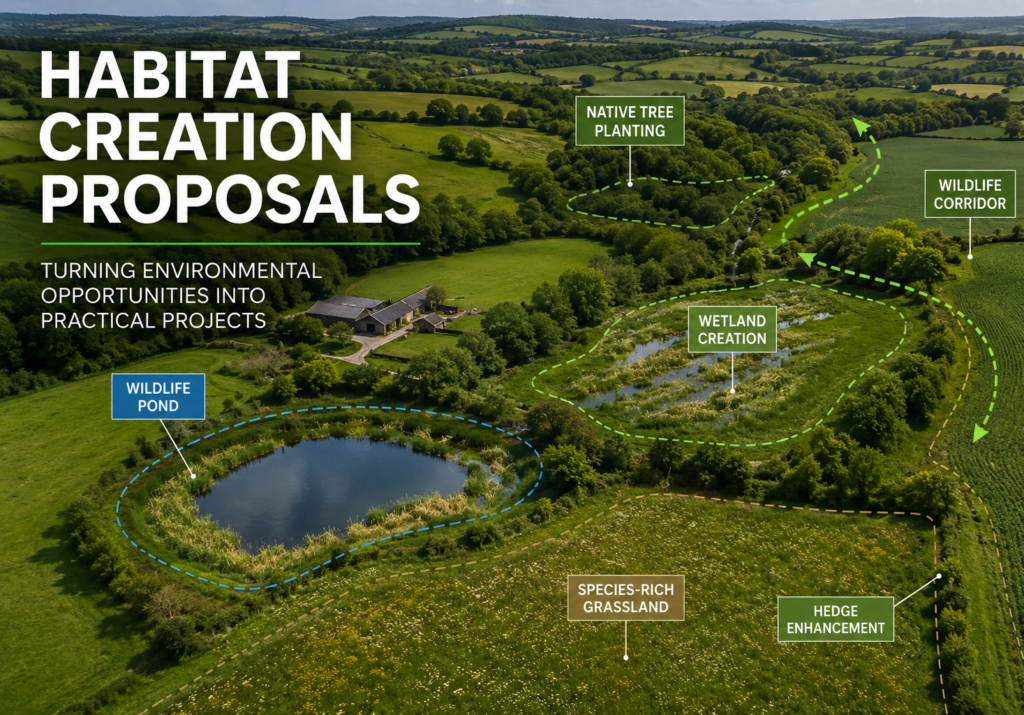
A practical proposal for ponds, scrapes, wetland cells, planting zones and associated works, shaped around the site, habitat objectives and realistic management.
View habitat proposals →A useful output
Enough detail to make the next decision well
The exact format follows the project, but the work is always written to be understandable and useful beyond the site visit.
What we observed
Relevant site conditions, water behaviour, access, constraints, photographs and existing information brought into one clear account.
What the evidence means
Practical routes forward, key uncertainties and the issues that should be resolved before a specification or budget is fixed.
What the work is intended to achieve
A defined proposal, method or habitat objective that clients, advisers and funding bodies can understand and assess.
What happens after the report
Recommended investigations, specialist input, delivery stages and—where appropriate—outline costs or a route to a construction quotation.
How it works
A short route from uncertainty to a practical brief
We establish the purpose first, so the visit and resulting information are focused on a real decision rather than a generic survey.
Clarify the decision
We review the site, project aim, documents already available and who needs to use the output.
Visit and assess
We inspect the relevant water, land, access and existing features, recording the evidence the brief requires.
Shape the response
Findings are translated into a practical scope, proposal or supporting document with clear assumptions.
Agree the next step
We identify delivery, further specialist work or information still needed before the project advances.
Clear professional boundaries
We lead where practical waterbody experience matters
Credible support also means being clear when a project needs a planning, ecological, engineering or legal specialist.
SAS Aquatics is well placed for
Waterbody and wetland feasibility, practical hydrology, site constraints, buildability, habitat scope, outline methods, construction costs and coordination with the wider project team.
If invasive plants affect the scheme, our aquatic and wetland plant control service helps bring identification, containment, staged control and restoration into the practical project scope.
Another specialist may be required for
Planning applications, statutory flood-risk modelling, protected-species surveys, formal engineering design, legal interpretation or other regulated work. We flag this early and can work alongside the appointed adviser.
A good first brief
Share what you know—even if the project is still taking shape
Early involvement can prevent the wrong layout, budget or application route becoming fixed. We can start with incomplete information and identify what needs resolving next.
Useful information to send
- The site location and approximate area
- Photographs, plans or an aerial image
- The outcome you want and who the document is for
- Known water, access, ecology or planning constraints
- Any funding guidance, reports or deadlines already available
Common questions
Before we visit
Can you tell us whether planning permission is required?
We can identify practical factors that may affect the project and provide supporting information, but the planning position depends on the site and proposal. Where formal advice or an application is needed, a planning professional or the relevant authority should confirm it.
Can you guarantee that a grant application will succeed?
No. Funding decisions belong to the grant provider. Our role is to help present a coherent, site-specific project with clear outcomes, methods and costs.
Do you provide formal hydrology or flood-risk modelling?
We assess waterbody behaviour, sources, levels and practical water-management questions. Statutory flood-risk work, catchment modelling or engineered structures may require a chartered hydrologist or civil engineer; we will make that boundary clear.
Can the support lead into construction?
Yes. Where the project is suitable, the assessment or proposal can become the basis for a detailed scope and construction quotation from SAS Aquatics.
Is the assessment fee credited against later work?
Where an assessment directly develops into a larger commissioned design or construction project, all or part of the fee may be credited. This is confirmed in writing before the visit and is not automatic for every project.
Can you work with our ecologist, land agent or planning consultant?
Yes. We regularly add practical waterbody and construction knowledge to wider project teams, helping translate objectives and recommendations into deliverable work.
Start with the site
Tell us what the project needs to achieve
Share the location, photographs and any plans, funding guidance or reports you already have. We will review the information and recommend the right paid assessment or defined piece of support. For delivery options, explore wetland creation in Devon and Cornwall and pond restoration in Devon and Cornwall.