How to Restore an Overgrown Farm Pond Without Stripping Out Its Wildlife Value
An overgrown farm pond is not necessarily a failed pond. Willow, scrub, reeds, leaf litter and silt can all provide habitat. The problem comes when one type of growth takes over, open water disappears and the pond loses the varied depths, light and wet margins that made it useful in the first place.
Good restoration is not about clearing everything back to a bare bowl. It is about recovering enough water, structure and management access for the pond to function again while retaining the best existing habitat.
When does an overgrown pond need restoration?
Some change is normal. Farm ponds naturally accumulate organic material, develop marginal vegetation and move between wetter and drier states. Seasonal ponds are valuable too, so drying in summer is not proof that a pond needs lining or deepening.
Restoration becomes worth considering when:
- scrub or trees shade almost the entire water surface;
- leaf litter and soft sediment have removed most of the original depth;
- reeds, willow or root mats dominate the whole basin;
- inlets, outlets or overflow structures are blocked or failing;
- steep or collapsed banks restrict shallow habitat;
- the pond no longer holds the water it once did;
- open water, wet margins and surrounding cover have become one uniform habitat;
- access for future management has been lost.
A useful first step is to separate the visible symptoms from the cause. Excessive shading, sediment, leaking, altered drainage and damaged overflow levels need different solutions.
Start with evidence, not the excavator
Before machinery arrives, establish how the pond behaves through the year and how it connects to the surrounding land. Photographs from wet and dry periods, old maps, previous work and the landowner’s memory can all help.
A practical assessment should consider:
- the original pond footprint and likely bed level;
- water sources, field drains, ditches and runoff routes;
- where the pond overflows and what lies downstream;
- sediment depth across representative areas;
- trees, scrub and vegetation worth retaining;
- suspected invasive aquatic and wetland plants that need identification and containment before clearance;
- possible protected species and surrounding terrestrial habitat;
- machine access, working space and where removed material can go;
- whether the aim is wildlife, water retention, landscape value or several outcomes together.
This is the basis of a credible pond restoration and habitat enhancement plan, rather than a generic clearance price.
How much tree and scrub clearance is sensible?
Trees are not automatically bad for ponds. Mature trees, low scrub, bramble, roots and fallen timber can provide cover, nectar, shade and terrestrial habitat. Complete removal can leave the pond exposed and reduce the structure around it.
Selective clearance is usually more useful. Priorities may include:
- opening the southern side where additional light will benefit the water and margins;
- removing young willow or scrub that is rapidly closing the basin;
- reducing branches responsible for heavy annual leaf fall;
- retaining selected mature trees and stable root structure;
- keeping logs and brash in planned habitat piles away from machinery and spoil areas;
- leaving refuge sections undisturbed during phased work.
The exact balance depends on the pond. A heavily shaded woodland pond may be valuable in its own right, while an old field pond that has only recently become enclosed may benefit substantially from reopening.
Does all the silt need removing?
No. Some sediment supports plants and invertebrates. Removing every trace of organic material is rarely necessary for a wildlife pond and can create a sterile result.
The useful question is how much depth and open water need recovering. Options include:
- targeted removal around an inlet, outlet or former deeper area;
- partial restoration that reopens selected water while retaining refuge margins;
- phased desilting across more than one working period;
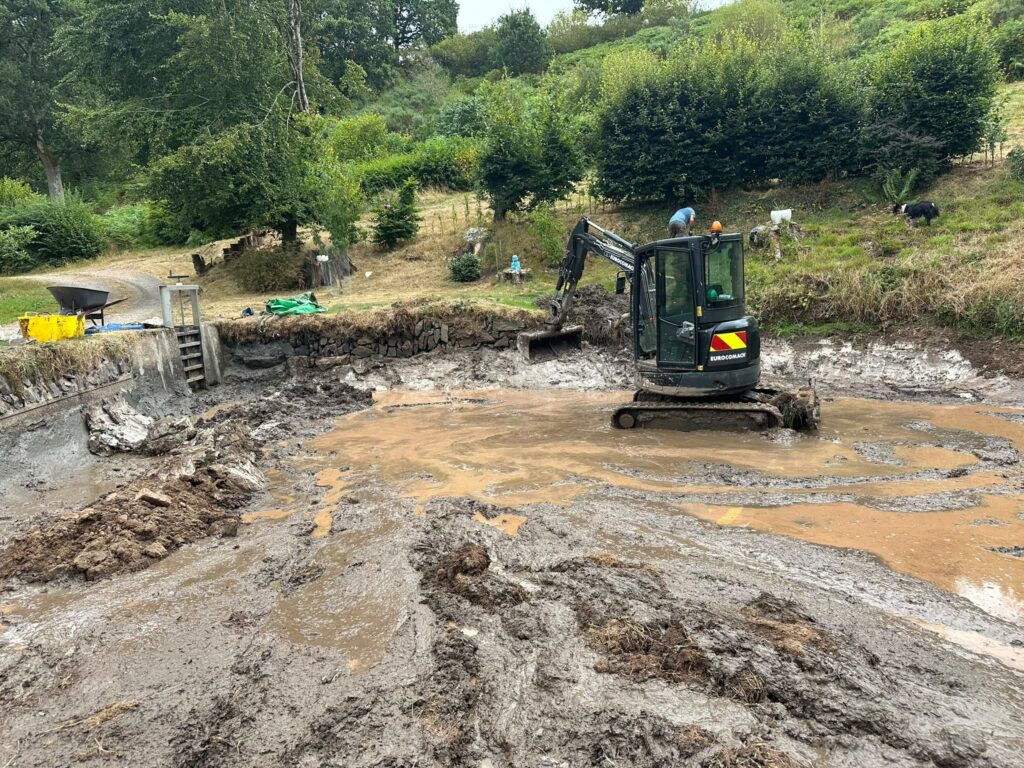
- wider clearance where accumulated material has effectively filled the original pond.
Our pond and lake desilting service compares those routes before setting the machinery and material plan.
Removed sediment also needs a lawful and workable destination. The source, volume, contamination risk, dewatering space and intended land use all affect the answer. Our guide to pond silt testing, reuse and disposal explains why this decision should be made before excavation starts.
Will restoration make an old clay pond hold water again?
It may, but it should not be promised simply because clay is present.
Removing silt and root material can expose the original bed and allow its condition to be assessed. In some ponds, careful reprofiling and compaction of suitable existing clay may improve retention. In others, the clay layer is too thin, mixed, cracked, disturbed by roots or simply unsuitable for reliable permanent water.
Restoration can therefore be exploratory. The first phase may recover the basin and reveal whether the existing ground provides a credible sealing route. If dependable year-round water is essential, the alternatives may include additional suitable clay, bentonite, geosynthetic clay liner or another lining system—but only after the site and intended use have been assessed.
A pond that remains seasonal can still be successful wildlife habitat. Permanent water should be a stated requirement, not an automatic measure of success.
Restore varied profiles, not maximum depth everywhere
A deep central area can help retain water and provide refuge, but wildlife value comes from variety. Useful restoration profiles may include:
- shallow, gently sloping margins;
- temporary drawdown and muddy edge zones;
- deeper pockets rather than one uniform bed;
- irregular edges and sheltered bays;
- safe overflow routes;
- damp ground and rough vegetation outside the waterline.
Old farm ponds often contain useful features beneath years of sediment. Excavation should follow the original landform where possible and avoid unnecessary enlargement or deepening without understanding the hydrology and downstream effect.
Retain habitat while machinery is working
The construction method matters as much as the finished shape. Before starting, define:
- which vegetation and banks are staying;
- where refuge habitat will remain;
- how machinery will reach the pond without damaging the whole margin;
- where water, silt, brash and timber will be managed;
- how exposed ground will be stabilised;
- how the pond will be left safe and able to recover.
Where a site has several ponds, rotational restoration can be particularly effective. Working on different ponds in different years preserves nearby habitat while building a more varied pond network.
When should an overgrown pond be restored?
There is no single date that is right for every pond. Ground conditions, water levels, breeding wildlife, fish, nesting birds and protected species all affect timing.
Defra’s current WBD1 pond-management guidance identifies September to November as a useful general period because water levels can be lower and nature can recolonise after the work. Natural England’s guidance for ponds that may support great crested newts gives different, species-specific advice and stresses assessment before work.
Major clearance, dredging or bank work should therefore have a site-specific method rather than relying on a calendar rule.
Protected species and ecological checks
Farm ponds and the rough ground around them can support protected species. Dense vegetation, dead wood and scrub may be terrestrial habitat as well as something that appears to need clearing.
Natural England lists pond restoration, scrub clearance, vegetation removal, ground disturbance and silt deposition among activities that can affect great crested newts. Its great crested newt guidance explains when surveys, avoidance measures or licensing may be needed.
The proportionate response depends on the site, the scale of work and existing evidence. The important point is to address it before contractors and machinery are committed.
Should the pond be planted after restoration?
Natural recolonisation may be the best approach where suitable plants already exist in the pond network. Retained root zones and undisturbed margins can help vegetation recover without importing unnecessary material.
Planting is useful where the restored profile has clear gaps, new shelves need establishing or the wider project requires a defined habitat mix. Any aquatic and marginal planting should match the water depths, soils, light and future management rather than being added as decoration.
Common mistakes in farm pond restoration
- Clearing every tree, reed and root at the same time.
- Assuming deeper always means better habitat.
- Promising permanent water before assessing the bed and catchment.
- Ignoring drains, ditches, overflows and downstream effects.
- Starting work without a sediment and spoil plan.
- Depositing silt over valuable terrestrial habitat.
- Leaving steep, uniform banks with no shallow margins.
- Creating a finished pond that cannot be reached for future management.
- Introducing fish where wildlife recovery is the priority.
What should a landowner send for an initial review?
Useful information includes:
- photographs from several sides, including access and surrounding land;
- approximate dimensions and known water depths;
- summer and winter water-level behaviour;
- the location of inlets, drains, ditches and overflows;
- what is known about the original construction or clay;
- previous clearance, excavation or sealing work;
- wildlife observations and any existing ecological records;
- where machinery could enter and where material might remain;
- the result you want from the restoration.
Farm pond restoration in Devon and Cornwall
SAS Aquatics restores overgrown and silted ponds for farms, estates, organisations and private landowners across Devon and Cornwall. We define what should be retained, what needs recovering and whether targeted, phased or wider intervention offers the best result.
Send photographs and site details through the large ponds, lakes, wetlands and landowner enquiry form. We will review the information first and confirm whether a site assessment is the right next step.
Frequently asked questions
Is an overgrown pond bad for wildlife?
Not automatically. Scrub, trees, reeds and organic sediment can all provide habitat. Restoration becomes valuable when the pond loses almost all variation, open water, light or practical function.
Can willow roots make a clay pond leak?
Roots can disturb an existing sealing layer, but the cause of poor water retention may also be unsuitable clay, altered drainage, cracking, animal activity or a failing overflow. The bed needs assessing once accessible.
Should a farm pond be completely drained for restoration?
Not in every case. The method depends on water depth, sediment, fish and wildlife, machinery access and whether phased or partial work can achieve the objective.
Can the removed timber be retained for habitat?
Often, yes. Suitable trunks, branches and brash can be placed in planned terrestrial habitat piles, provided they do not block access, drainage or the pond’s overflow route.