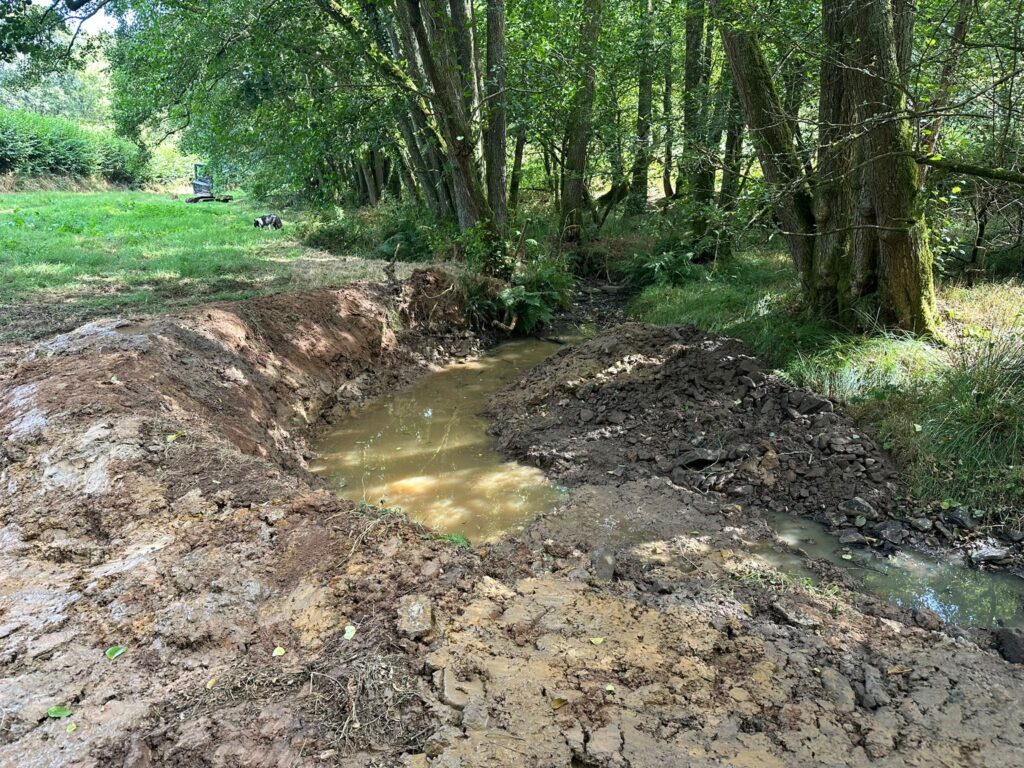
Can You Build a Pond Fed by a River or Stream?
Yes, it can be possible to build a pond fed by a river or stream. Whether you should depends on the water quality, seasonal flows, effect on the watercourse and permissions required. For a new wildlife pond, our starting recommendation is to assess whether it could work with a clean water source independent of the stream.
A stream running through your garden, field or smallholding can look like the obvious way to fill a pond. A gravity feed may avoid the need for a pump, and flowing water can seem more reliable than waiting for rain.
However, connecting a pond to a watercourse also connects it to what happens upstream. Before excavating, it is worth comparing the different ways the pond could be supplied.
Three ways to build a pond near a stream
The water connection changes how the pond works, what needs maintaining and which permissions may apply.
A pond described as “offline” is outside the main channel; it is not necessarily disconnected from river water. Make the proposed inlet, outlet and flood connections clear when discussing a design.
Is a stream-fed pond a good idea?
Flowing water is not necessarily clean water
A clear-looking stream can carry dissolved nutrients and other pollutants. Once connected, your pond receives water from the wider upstream catchment, potentially including drainage from farmland, roads and developed areas.
Freshwater Habitats Trust advises avoiding stream inflows when creating clean-water wildlife ponds because they can introduce pollution and increase long-term management problems. See its guidance on pond locations and water sources.
Our practical recommendation is to investigate the catchment and assess water quality under different conditions. One sample on a dry day provides only a snapshot. Our article on pollution runoff after drought explains why the first substantial rain can be a particularly useful time to understand the incoming water.
The pond can become a sediment trap
As stream water slows in a pond, sediment can settle out. Over time this reduces depth and creates a recurring desilting task. The rate depends on the catchment and flow, so there is no dependable universal maintenance interval.
Freshwater Habitats Trust identifies faster silt accumulation as a particular drawback of ponds with inflows. A maintainable settlement area may help with sediment, but should not be assumed to remove dissolved pollution. The sensible design question is whether the inflow benefits the pond enough to justify managing it. Read the floodplain pond guidance.
Summer supply and winter flows are different problems
For feasibility, we would ask what happens during a prolonged dry spell, how much water the pond loses and what happens when the stream floods. A design that only works while a constant inflow masks leakage is vulnerable when that supply falls.
The assessment should also establish what happens if the inlet blocks, the outlet cannot discharge, or floodwater reaches the pond from another direction. We recommend designing the normal overflow and the route for excess water together, with downstream land and structures in mind.
Water physically present in a stream is not necessarily available for abstraction. Local water availability and licence conditions can limit what can be taken. Check the Environment Agency’s abstraction application guidance before relying on a stream supply.
The stream already supports habitat
Creating a pond should improve the site as a whole. A river connection can provide access for fish, while a separate pond can offer a different habitat. Freshwater Habitats Trust’s floodplain pond guidance describes both the value of connected fish nurseries and the water-quality advantages of appropriately located, separate ponds.
Where the objective is river restoration, a carefully designed backwater or fish refuge may be appropriate. Where the objective is a clean wildlife pond, routing the stream through it may add problems without helping that objective.
A controlled side feed can be worth investigating where water quality and permitted availability are suitable, the connection provides a clear benefit, and the owner can maintain the inlet and outlet. We would want the proposal to show how it protects the stream during low flows and manages excess water during storms.
What permissions do you need for a river- or stream-fed pond?
This section covers England, including Devon and Cornwall. Other UK nations have different arrangements. Guidance checked on 11 September 2026.
There are several separate questions to resolve. Planning permission alone does not settle abstraction or watercourse consent requirements.
Taking water: abstraction
Taking water from a river or stream is abstraction. A gravity feed should be assessed as an abstraction just as a pumped supply would be; returning water downstream does not automatically remove the licensing question.
The Environment Agency says you are likely to need an abstraction licence if you take more than 20 cubic metres, or 20,000 litres, a day. Its small-abstraction exemption applies to a single operation taking 20 cubic metres or less a day; where water is taken from the same source at several points, the combined total matters. See the official abstraction guidance.
For scale, a continuous feed of just one litre per second takes 86,400 litres in 24 hours. A modest-looking flow can therefore exceed the daily threshold. Being below that threshold does not authorise dams, channel alterations or other regulated work.
Holding back water: impoundment
A dam, weir or other structure that changes the water level or flow can be an impoundment. An impounding licence is generally required before constructing, altering or removing one, subject to specific exemptions and regulatory positions. This is a separate question from the volume abstracted. Check the Environment Agency’s impoundment guidance before proposing a barrier across a stream.
Working in or near the watercourse
For a designated main river, works may need an Environment Agency flood risk activity permit. The rules can apply to nearby excavation and floodplain work as well as structures in the channel. The guidance specifically identifies excavation within 16 metres of a main river, flood defence or culvert as a potentially regulated activity.
For an ordinary watercourse, contact the lead local flood authority or internal drainage board, where applicable, about land drainage consent. Use the official main river map rather than judging the category from the size of the stream. Both routes are explained in the flood risk activity guidance.
Planning, ownership and ecology
Ask the relevant local planning authority whether the pond and associated earthworks need planning permission. Within a National Park this will normally be the National Park Authority.
Owning the land does not give unrestricted permission to alter the watercourse. Boundaries, other owners’ rights and access arrangements also matter; even a channel that dries out for long periods can be a watercourse. The Environment Agency’s watercourse ownership guidance is a useful starting point.
Check protected species, designated sites and fish or eel passage requirements early. These may affect the location, design and timing of work. The Environment Agency flags fish and eel passage in its licence application guidance.
Does habitat creation qualify for simpler rules?
Some specific nature-recovery activities, including qualifying backwaters and fish refuges, may fall within RPS 374. This sets conditions under which the Environment Agency will normally not take enforcement action over abstraction licensing; it does not remove the underlying legal requirement.
It requires compliance with all applicable conditions and notification before abstraction starts. It is not blanket permission for wildlife ponds, and separate approvals still apply. Read the current official RPS 374 or our practical introduction to RPS 374.
Could a separate wildlife pond be a better option?
For a new wildlife pond, we would compare the stream-fed proposal with a pond supplied by rainfall, clean runoff from suitable surrounding land, or groundwater where conditions allow.
That does not mean directing every field drain into the pond. The quality of the contributing land and water matters. Nor does a pond need a permanent inflow to avoid becoming “stagnant”: clean water, suitable habitat and a design matched to seasonal levels are a sound starting point. Freshwater Habitats Trust’s clean-water pond guidance explains the value of both permanent and seasonal ponds.
A separate pond can still sit within a wider area of rough grass, wetland margins and other habitats. Equally, an existing spring or wet flush may already be valuable and should be assessed before being excavated or redirected.
Is a stream-fed pond cheaper to build?
It may save pumping where the levels allow a gravity supply, but our advice is to compare the whole project cost: investigations, permissions, inlet and outlet works, water management during construction, sealing and future maintenance.
A dependable comparison needs a feasible design for each option. Our pond construction cost guide explains the wider factors that shape a construction budget.
Common questions about stream-fed ponds
Can I use a small stream that runs entirely through my land?
Potentially, but ownership and stream size do not answer the consent questions. Establish the watercourse category, proposed abstraction and any alterations before proceeding.
Do I still need a liner if the pond has a constant supply?
Possibly. We would assess the soils, groundwater and expected water balance before specifying the sealing method. A constant feed should not substitute for understanding how the pond will retain water in dry weather.
What if the pond is beside the river but has no inlet?
Check whether floodwater can still enter it, and whether its groundwater levels are linked to the river. Its position may also bring the excavation within flood risk permitting rules.
Pond & wetland projects · Devon & Cornwall
Could a pond work beside your stream?
Tell us about the site and what you would like to achieve. We’ll review your enquiry, discuss suitable options and confirm whether a site assessment would be useful.
A useful starting point
- The site address and postcode
- Photos of the stream and proposed pond area
- Approximate pond size and what it is for
- Anything you know about summer drying, flooding or machinery access
You do not need a finished design to get in touch.
SAS Aquatics designs, builds and restores wildlife ponds for landowners, farms and estates, alongside wetlands and wider habitat projects.