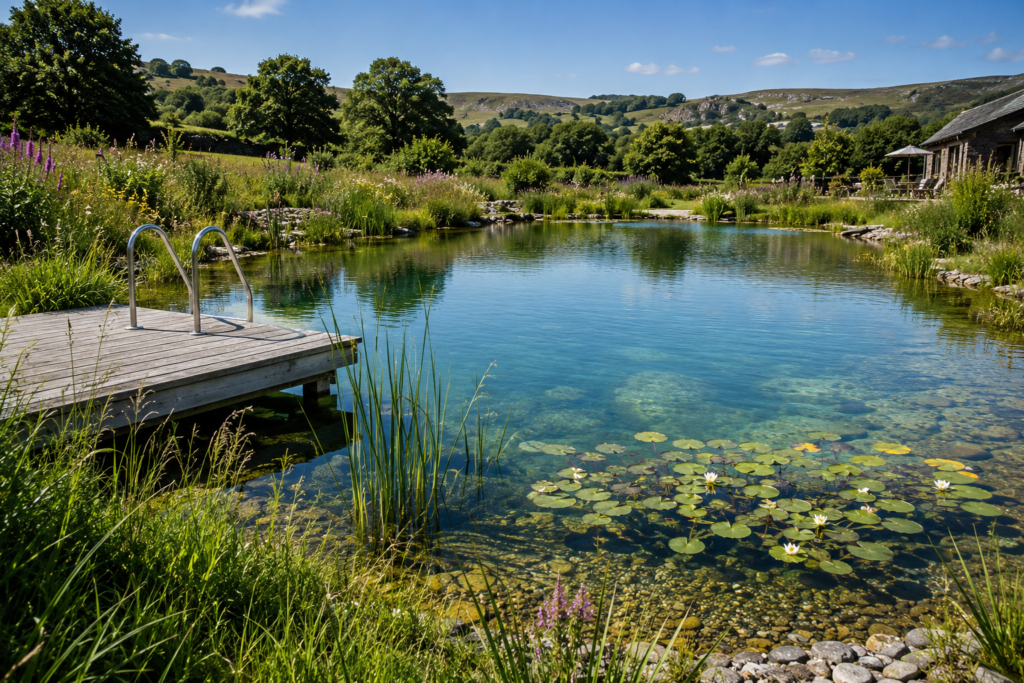
Fully Natural Swimming Ponds in Devon & Cornwall
Fully natural swimming ponds · Devon & Cornwall
Swim in a living landscape
Fully natural swimming ponds use space, depth, planted regeneration and careful nutrient management to create swimmable water with very little visible technology. They suit people who value ecology and seasonal character as much as the swim itself.
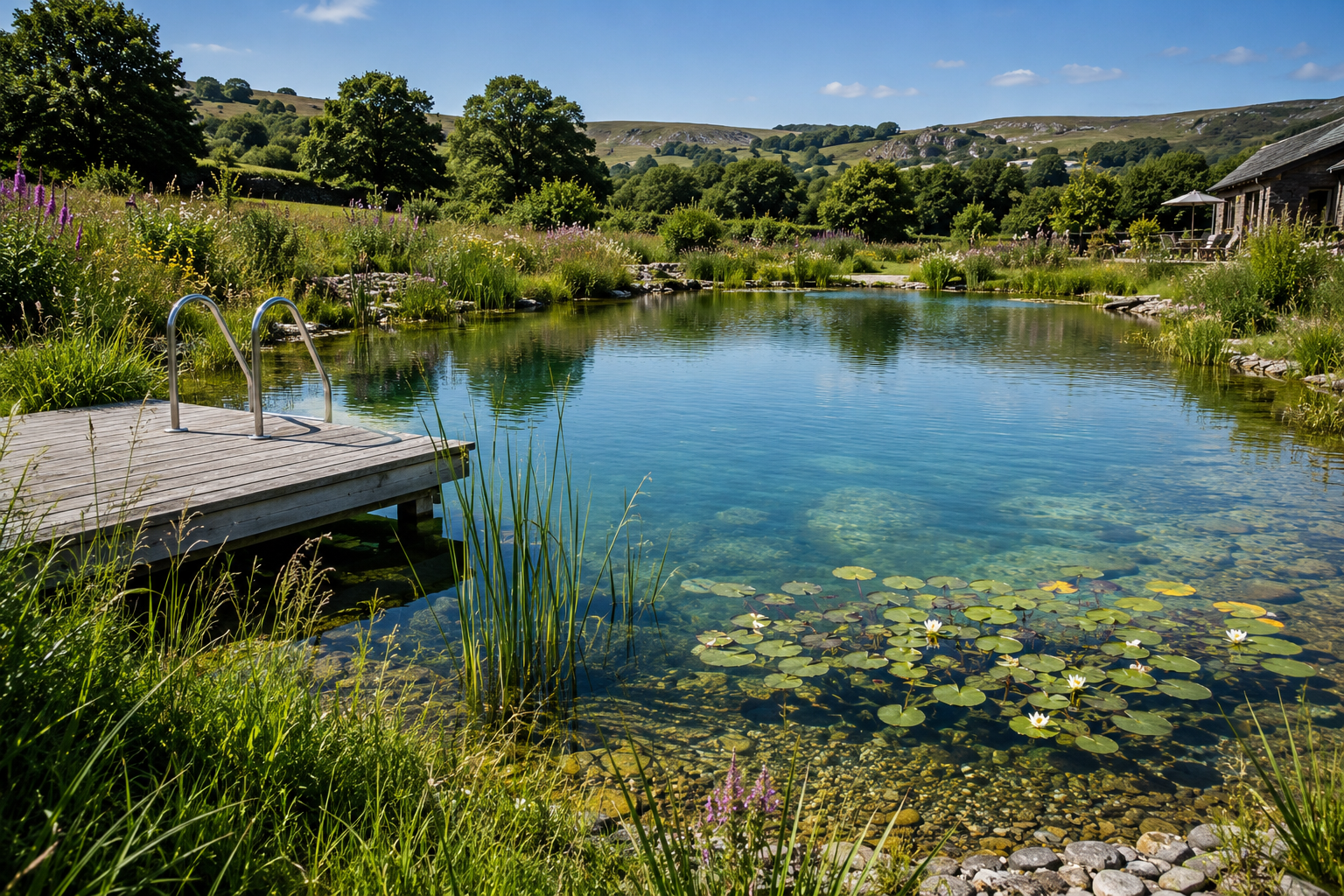
Landscape-led swimming
More than a pool without chlorine
The swimming area and regeneration zones form one connected waterbody. Planting, microbial activity, appropriate depths and controlled nutrient inputs support water quality without routine chlorine as the primary treatment. The result should feel like part of its landscape rather than a conventional pool disguised by plants.
A fully natural route normally needs enough area for planted treatment and a client who accepts natural change. If space is tight or more controlled clarity is the priority, a hybrid system may be the better fit.
When fully natural is the right ambition
The strongest projects start with an honest match between the site, available area, water expectations and willingness to manage a living system.
Room for regeneration
Planted treatment zones need meaningful space. Their scale and relationship with the swimming area are developed around loading, depth, circulation and site conditions.
A landscape, not a pool finish
Informal edges, planting, stone, timber and habitat margins create a water feature that remains valuable outside the swimming season.
Comfort with natural change
Water colour, plant growth and wildlife activity will vary. Good design manages the system, but it does not make it behave like a heavily treated pool.
Ecology matters too
A fully natural pond can combine recreation with planted habitat, provided swimming safety, nutrient loading and wildlife objectives are resolved together.
How the water is supported
Design the nutrient balance before choosing the details
Runoff, leaf fall, soil, livestock, swimmers, planting and source water all influence the pond. The design must reduce avoidable nutrient inputs, provide appropriate treatment area and make seasonal management practical.
- Swimming depths and access developed around intended use
- Regeneration zones sized for the actual site and loading
- Inflow, runoff, overflow and surrounding land considered early
- Planting selected for treatment, structure and landscape fit
- Seasonal care and future access built into the design
- Machinery access, spoil handling and the construction route assessed early
- Natural stone, gravel and edge materials selected for the site and safe use
From site understanding to a living pond
Fully natural systems rely on the relationship between land, water and long-term management, so feasibility comes before a fixed shape or price.
Share the site
Send photographs, location, approximate dimensions, access, levels if known and what matters most about swimming and habitat.
Read the landscape
We consider available area, water source, runoff, levels, ground conditions, access and the practical treatment options.
Balance the zones
The swimming area, regeneration, edges, access, planting, overflow and wider landscape are developed as one system.
Build and establish
Construction and planting are followed by clear handover advice, because establishment and seasonal management affect long-term behaviour.
Professional feasibility
Enough information before a major commitment
Where levels, hydrology, access, soil, source water or the available regeneration area cannot be judged remotely, professional assessment starts from £500 + VAT. It identifies the main constraints, credible routes and whether fully natural or hybrid treatment is the better direction.
The assessment boundary
- It provides a practical site review and recommended route.
- It is not automatically a detailed construction design, structural report, planning application, ecological survey or laboratory water analysis.
- A £250 + VAT credit applies to qualifying construction or refurbishment of at least £10,000 + VAT commissioned within six months.
- Additional surveys, permissions or specialist work are agreed separately where required.
Useful questions
Before choosing fully natural
Will the water always be clear?
No natural system should be sold with that guarantee. Good design and management can support excellent swimming conditions, but weather, nutrients, plant growth and seasonal change still affect the water.
Does it need pumps or filters?
Some fully natural designs use modest circulation or skimming, while others rely more heavily on passive processes. “Fully natural” does not mean no pumps, management or intervention in every case; the correct approach depends on site geometry, water movement and reliability.
Who is a fully natural swimming pond not suitable for?
It is unlikely to suit a compact site with little room for planted regeneration, or anyone who expects chemically treated, pool-like clarity every day and has little tolerance for algae, insects, wildlife or seasonal change. A selective hybrid may be more appropriate where the site and maintenance commitment justify it.
What construction access is normally needed?
Excavation, liner or waterproofing work, stone, gravel and planting usually require practical machinery access, a route for deliveries and a plan for handling spoil. Restricted access can materially change the programme, method and cost.
Can wildlife share the pond?
Often, yes, particularly around dedicated planted and marginal zones. The design still needs to balance habitat value with safe access and the intended swimming use.
Is maintenance unnecessary?
No. Leaves, sediment, planting and nutrient inputs still need management. The work may use less treatment equipment than a hybrid system, but it remains an actively cared-for landscape.
Can an existing pond become a swimming pond?
Sometimes. Depths, waterproofing, water source, sediment, banks, access and the available regeneration area must be assessed before a safe and credible route can be proposed.
Start with the land and water you have
Send the location, photographs, approximate dimensions and what you want from swimming, planting and habitat. We will review the information before recommending the most useful next step.