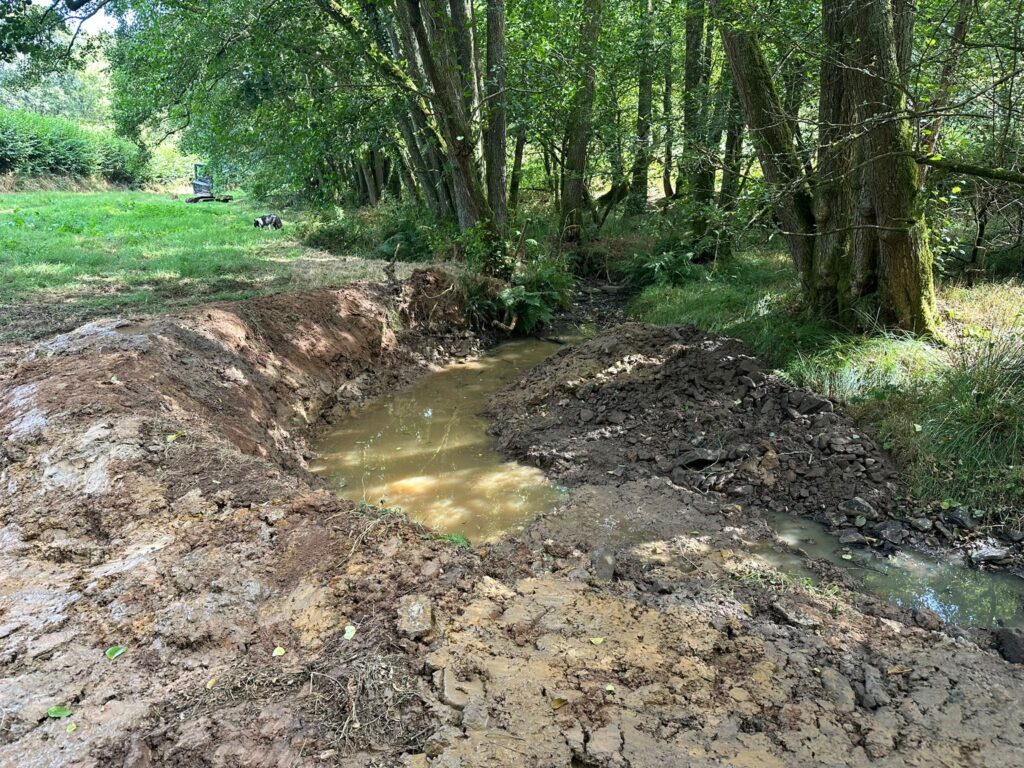
Fish Refuge & River Backwater Habitat Creation
River, floodplain & wetland habitat
Fish Refuge & River Backwater Habitat Creation
Create quieter water, stronger habitat and more space for rivers to recover. We help landowners, estates, farms, river trusts and conservation projects plan and deliver fish refuges, backwaters, side channels and connected wetlands across Devon and Cornwall.
A better-connected waterscape
Give streams and rivers more room to support life
A well-sited backwater or fish refuge adds valuable low-velocity habitat beside a stream or river. It can combine quieter nursery water, high-flow shelter, varied depths, damp margins, aquatic planting and a richer transition between the river, floodplain and wetland.
The result can benefit fish, aquatic invertebrates, amphibians, marginal plants and riverside wildlife while making the wider habitat network more resilient through changing seasonal conditions.
High-flow shelter
Quieter connected water can give fish somewhere to move away from the strongest river flows.
Nursery habitat
Shallow, warmer and well-vegetated margins can support juvenile fish and aquatic invertebrates.
Connected wetland
Backwaters, scrapes and side channels can strengthen the link between river and floodplain.
Useful sediment settling
Some offline features can also help fine sediment settle before it reaches connected ponds lower down.
Good design makes the difference
Designed beside the river, not built across it
This opportunity is not about putting a pond in the middle of a stream. It is about creating several varied, well-connected habitats beside the main channel and planning how they work together.
Levels and connections: consider when water enters, how long it remains and how the feature behaves at low and high flows.
Fish safety: avoid stranding, unsuitable velocities and poorly considered inlets or outlets.
Habitat variety: combine depths, shelves, damp margins, structure and planting rather than creating one uniform basin.
Future management: plan access, vegetation, sediment and maintenance from the outset.
A more workable regulatory route
Could Environment Agency RPS 374 help?
RPS 374 is an Environment Agency regulatory position for specified low-risk abstraction associated with nature-recovery actions and fish or eel passage. It is not an abstraction-licence exemption, but where every condition is met the Environment Agency says it will normally not take enforcement action for the abstraction covered by the position.
The opportunity
The recent position can make carefully planned habitat creation more achievable for suitable sites. We screen it as one possible route and help identify what evidence and permissions may be needed.
The feature still has to qualify
For a backwater or fish refuge, it must be a blind channel closed at one end with no outlet, form part of a nature-recovery action with a primary ecological aim, and remain safe for fish at all times.
Other permissions remain separate
A flood risk activity permit, ordinary-watercourse consent, Natural England consent, planning requirements or an impounding licence may still apply, depending on the site.
The Environment Agency must be notified before abstraction starts, and the required assessment, survey, plan and photographic records must be retained for six years after the activity permanently stops. Read the official Environment Agency RPS 374.
Suitable projects
Who this service is for
You do not need to arrive with a finished design or know whether RPS 374 applies. Start with the habitat opportunity, the location and what you already know about the watercourse.
Landowners, farms and estates
For practical habitat creation beside a watercourse, nature-recovery planning, biodiversity projects and natural-capital opportunities.
River and wildlife organisations
For river trusts, wildlife groups and community-led restoration schemes looking for buildability and delivery input.
Consultants and project teams
For organisations seeking an experienced wetland contractor to contribute practical construction, access, spoil, planting and aftercare knowledge.
A proportionate route forward
How we take a project from opportunity to habitat
Free initial review
Send the location, photographs, ecological objective and any plans or regulator correspondence through the dedicated enquiry form.
Professional site assessment
Where the opportunity looks viable, we scope a site visit from £500 + VAT to understand levels, flows, access, land control, permissions and practical constraints.
Concept and permissions route
We set out a proportionate next step. Specialist hydrology, ecology, surveys, detailed design, written reports and regulator input are separately scoped where required.
Construction and establishment
Where suitable, SAS Aquatics can price and deliver the channel and wetland works, including access, spoil management, planting and aftercare.
Part of the wider landscape
Related expertise for connected projects
Start with the habitat opportunity
Tell us what you want to create
Share the location, photographs and what you know about the watercourse. We will screen the opportunity and explain whether a professional assessment is the sensible next step.
A qualifying £250 + VAT assessment credit may be available when SAS Aquatics is appointed for qualifying construction or major refurbishment work of at least £10,000 + VAT within six months. We will confirm eligibility in the assessment proposal.
SAS Aquatics provides practical site assessment, habitat-led construction and project support. Regulated ecological surveys, legal advice and specialist engineering are not included unless specifically agreed and may be provided by suitably qualified partners.