What Happens to Pond Silt After Desilting? Testing, Reuse and Disposal Explained
Removing sediment from a pond or lake is only half of a desilting project. The other half is deciding what happens to the material once it leaves the water.
Pond silt disposal affects the machinery, programme, access requirements and cost of the work. On some sites, suitable non-hazardous material can be dewatered and managed close to the pond under the correct exemption. On others, the silt needs testing, controlled storage, transport and an authorised recovery or disposal route. That decision should be made before an excavator arrives.
The short answer: pond silt needs a planned route
There is no single answer that applies to every pond. The correct route depends on:
- where the sediment has come from;
- whether there is any risk of contamination;
- whether invasive aquatic or wetland plants require a species-specific containment and handling plan;
- the likely volume and consistency;
- where it could be dewatered without causing runoff;
- whether its use would genuinely benefit land;
- the distance between the water and the proposed deposit area;
- the conditions of any waste exemption or environmental permit.
A practical pond and lake desilting plan considers the material route alongside water management, machinery access, ecology and the restoration objective.
Is dredged pond silt classed as waste?
Material removed from inland water and discarded is generally managed as dredging spoil. The Environment Agency uses waste code 17 05 06 for non-hazardous dredging spoil and 17 05 05* for hazardous dredging spoil.
The important point is that appearance alone does not settle the classification. Dark, organic silt is not automatically hazardous, and clean-looking sediment is not proof that it is suitable for unrestricted reuse. The history of the pond, its inflows and the intended destination all matter.
The Environment Agency requires waste to be identified and classified before it is sent for recovery or disposal. Its current waste-classification guidance explains the responsibilities and the records needed.
When should pond silt be tested?
Laboratory testing is more likely to be needed where the source or history creates uncertainty. Examples include ponds receiving road runoff, drainage from commercial or industrial areas, sewage inputs, fuel or chemical contamination, historic dumping, or material that may need to leave the site.
Testing can also be required to demonstrate that the sediment is non-hazardous or suitable for a proposed recovery route. The sampling plan matters: one convenient scoop from the bank may not represent a large pond with different inlets, depths and sediment layers.
For straightforward rural ponds with a clear history and a compliant on-site route, the assessment may be simpler. The correct approach should still be agreed from the evidence rather than assumed.
Common routes for material removed from ponds and lakes
1. Deposit and dewater beside the waterbody
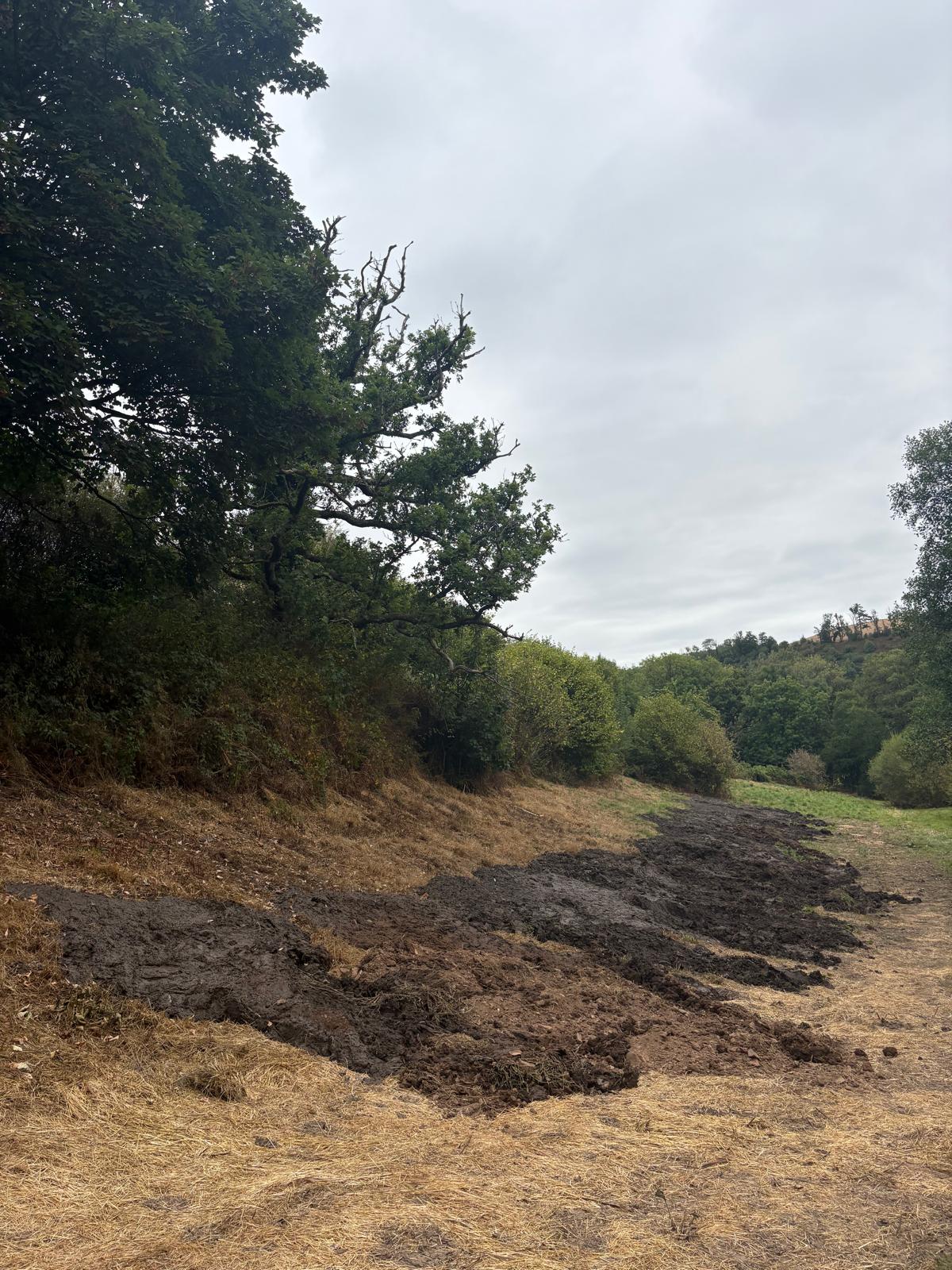
The Environment Agency’s D1 waste exemption can allow non-hazardous dredging spoil to be deposited, screened and dewatered at the closest possible point to the inland water from which it was removed. Conditions and quantity limits apply, and the exemption must be registered before it is used.
This can be a practical route where there is suitable adjoining land, safe access and enough space to contain wet material. It does not mean silt can simply be tipped anywhere on the property. Runoff, watercourses, neighbouring land, public access and the final spreading area all need to be considered.
2. Use the material to benefit land
Some non-hazardous dredging spoil from maintaining habitats, ditches or ponds may be spread on non-agricultural land under a registered U11 waste exemption. The use must provide a genuine benefit to the land and remain within the permitted waste types, quantities, storage rules and other conditions.
This route can suit carefully planned habitat or landscape work, but “there is a field available” is not enough on its own. The receiving area, intended benefit, ground conditions and pollution risk need to support the proposal.
3. Send the silt to an authorised facility
If the material cannot remain on site under a suitable exemption, it may need to go to a permitted recovery or disposal facility. That brings additional handling, haulage and paperwork into the project. Wet silt can be especially awkward to transport, so dewatering and loading arrangements have to be defined.
The Environment Agency summarises the available exemptions and permit routes in its guidance on depositing dredged waste on land.
Why the material route changes the cost of desilting
The cheapest-looking excavation method is not necessarily the cheapest completed project. A machine may remove silt quickly, but the job can stall if there is nowhere lawful and practical to put it.
The main cost drivers usually include:
- the area, depth and consistency of the sediment;
- whether the whole pond or selected areas need clearing;
- water lowering, bypassing or temporary management;
- machine reach and safe access around the banks;
- the distance to a dewatering or loading area;
- testing and classification requirements;
- containment, runoff control and reinstatement;
- haulage and disposal charges where material leaves the site;
- bank, inlet, outlet, liner or habitat work revealed during excavation.
This is why larger schemes normally begin with a site assessment rather than a price based only on surface dimensions. Our lake and large pond restoration service considers silt, water, structures and land logistics as one project.
How is the amount of pond silt estimated?
Reliable estimates need more than measuring the pond’s length and width. Sediment rarely sits at a uniform depth. Inlets, deeper areas, reed margins and old channels can contain very different amounts.
A useful assessment may combine:
- probing across a planned grid or representative transects;
- recording water depth and the depth to a firm bed;
- mapping soft sediment, vegetation and obstructions;
- checking access and machine working positions;
- identifying areas that should be retained as habitat;
- estimating separate volumes for targeted and full-restoration options.
The result should be treated as a practical estimate, not false precision. The bed condition, buried debris and water content only become fully visible as work progresses.
Does all the silt need to be removed?
No. Some accumulated material supports established plants and invertebrates, while complete clearance can remove useful habitat and increase disturbance. The aim is to recover the depth, water movement or function the pond needs.
Targeted removal may be enough to reopen an outlet, restore a deeper refuge, clear a blocked channel or rebalance open water and vegetation. Larger sites can also be restored in phases, leaving refuge areas while improving access and future management.
Where the problem extends beyond sediment, pond restoration and habitat enhancement may combine selective desilting with bank work, reprofiling, planting, inlet or outlet repairs and improved overflow management.
What should a landowner prepare before requesting a quotation?
The following information makes the first review much more useful:
- clear photographs of the pond, banks, access and surrounding land;
- approximate dimensions and any known depths;
- where water enters and leaves the pond;
- the history of the site and any possible contamination sources;
- how quickly the pond has silted up and any previous clearance work;
- possible areas for dewatering or retaining material;
- gate widths, slopes, bridges, overhead services and other access limits;
- whether the priority is depth, drainage, amenity, fishing, wildlife or a wider habitat restoration.
Projects involving uncertain sediment, consents or a multi-stage restoration may also benefit from our planning and environmental support before the construction scope is fixed.
Planning pond or lake desilting in Devon or Cornwall
SAS Aquatics plans and delivers desilting and restoration for farm ponds, estate lakes, wildlife ponds and larger waterbodies across Devon and Cornwall. We define the purpose of the work, investigate the likely sediment volume and agree a realistic material route before plant and labour are committed.
Send photographs and site details through the pond and lake desilting enquiry form. Include any available information about access, depths, inflows and where removed material might be managed.
Waste rules and exemption conditions can change. The current Environment Agency guidance and the specific circumstances of the site should be checked before work begins.
Frequently asked questions
Can pond silt simply be spread in a nearby field?
Not automatically. The material must be suitable, the proposed use must fit an exemption or permit, and the location, quantities and pollution controls must meet the relevant conditions.
Is all black pond silt hazardous?
No. Colour and smell can provide useful warning signs, but they do not replace an assessment of the source, site history and classification requirements.
Can silt stay beside the pond to dry?
It may be possible under the D1 exemption where all conditions are met. The closest deposit point, containment, runoff risk, quantities and final spreading arrangement need to be planned.
Will testing provide an exact disposal price?
Testing can help establish classification and suitable routes, but the final cost also depends on volume, water content, access, dewatering, loading, haulage and the receiving facility.