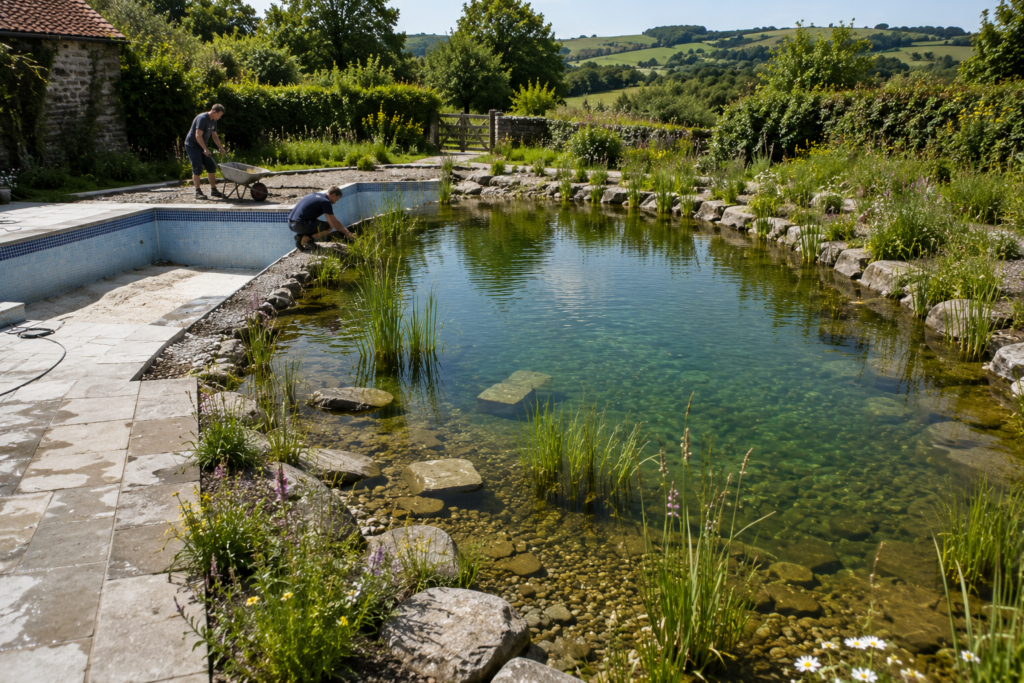
Swimming Pond Conversions
Swimming pond conversions · Devon & Cornwall
Start with what is already there
Existing pools, ponds and larger waterbodies can sometimes become natural or hybrid swimming ponds. The useful question is not simply “can it be converted?” but which parts are safe, durable and worth retaining.
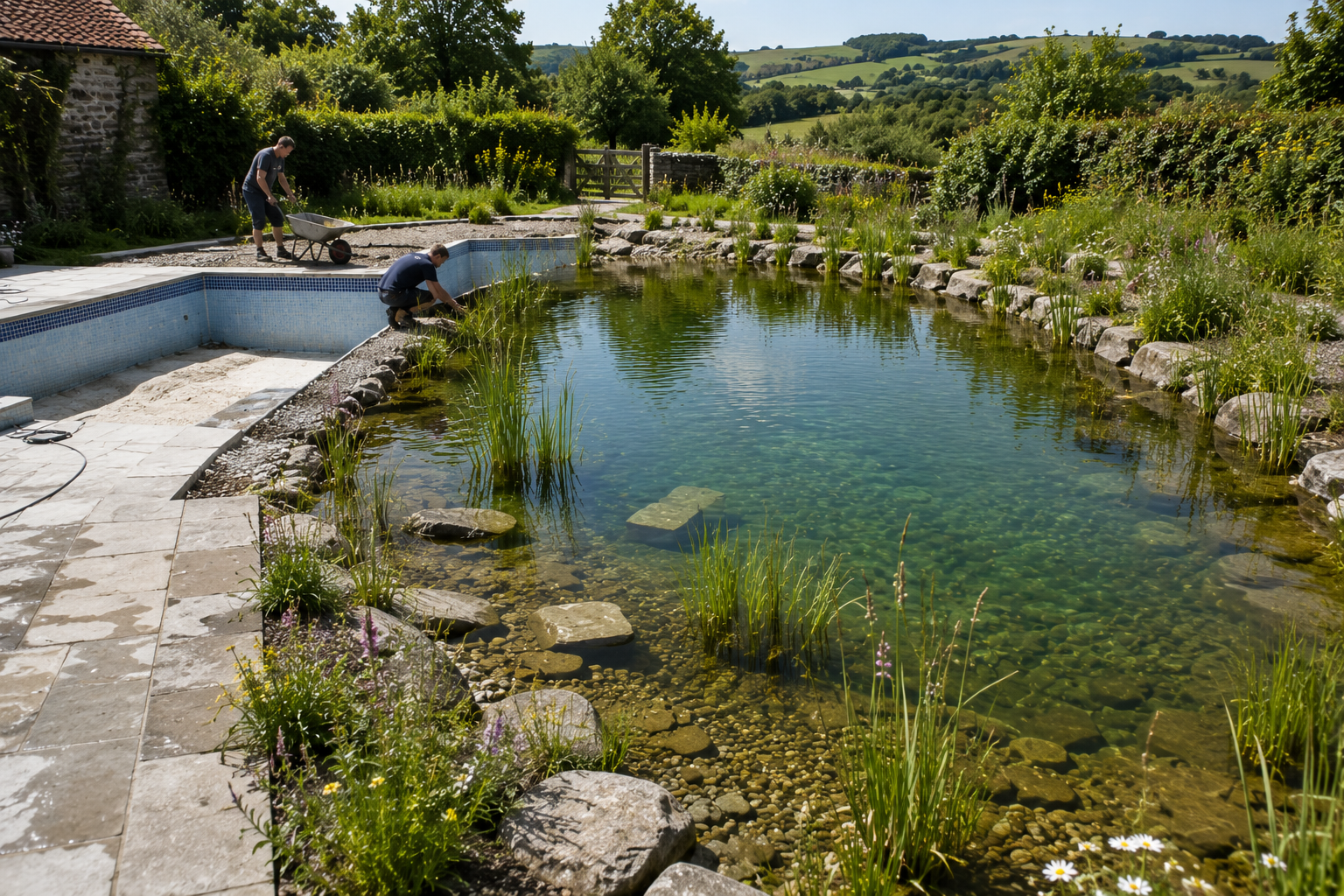
Assess before altering
Retain the right parts. Rebuild the wrong ones.
A conversion may preserve useful excavation, walls, services or established landscape character. It can also expose failed liners, unsuitable depths, weak structures, poor hydraulics or no practical space for regeneration and treatment. We compare refurbishment, conversion and replacement before recommending a route.
A conversion is not automatically cheaper, quicker or less disruptive than a new build. The condition of the existing water feature and the amount of reconstruction required determine whether reuse offers real value.
Different starting points need different answers
Conversion can mean adapting a sound pool shell, reconstructing an ornamental pond, defining a safer swimming area within larger water or deciding that replacement is the better long-term choice.
Existing swimming pools
Shell condition, waterproofing, pipework, levels, plant space and how a natural landscape can meet the retained structure all need to be resolved.
Garden and ornamental ponds
Depths, banks, liners, sediment and access are reviewed before deciding whether enlargement, reshaping or full reconstruction is required.
Lakes, farm ponds and reservoirs
Water quality, catchment, inflow, sediment, slopes, structures and safe separation of swimming from other uses can make these complex projects.
Ageing or underperforming swimming ponds
Where a natural or hybrid pond already exists, renovation may include relining, sediment removal, planted-zone renewal or the removal and simplification of failing filtration.
What the assessment looks for
The hidden condition matters as much as the visible water
Photographs are an excellent first step, but they rarely confirm structural condition, waterproofing, buried services, levels or the quality of retained material. Those uncertainties should be understood before promising savings or setting a construction scope.
- Structure, liner, banks and retained materials
- Depth profiles, entry points and safe movement around the water
- Inflow, runoff, overflow, sediment and water-quality pressures
- Space for planting, treatment equipment and future access
- What can be retained without compromising the finished system
- Relining, leak repair or replacement of failed waterproofing
- Restructuring planted zones and simplifying unreliable filtration
- Improving entry, access, swimming depths and edge profiles
- Sediment removal, planting renewal and practical future maintenance
A conversion route built on evidence
The aim is to avoid spending money preserving elements that will limit safety, appearance, treatment or future maintenance.
Show the starting point
Send current and historic photographs, dimensions, known construction details, problems, access and what you want the finished water to achieve.
Test the assumptions
We review condition, levels, water pressures, treatment space, landscape fit and the practical limits of retention.
Compare real routes
Retained conversion, partial reconstruction and replacement are compared alongside fully natural or hybrid treatment.
Rebuild coherently
Structural work, waterproofing, water management, equipment, planting, access and landscape finishes are coordinated as one project.
Professional feasibility
Conversions usually need a proper site view
Where condition, levels, waterproofing, sediment, water source or treatment space cannot be judged remotely, professional assessment starts from £500 + VAT. It identifies what is worth retaining, the main risks and whether conversion, refurbishment or replacement offers the strongest route.
What the initial assessment covers
- A practical review of the existing feature and credible next steps.
- It is not automatically a structural survey, detailed design, planning application, laboratory analysis or intrusive investigation.
- A £250 + VAT credit applies to qualifying construction or refurbishment of at least £10,000 + VAT commissioned within six months.
- Any opening-up work, specialist surveys or permissions are agreed separately where required.
Useful questions
Before assuming it can be reused
Can any existing pond become a swimming pond?
No. Some are too shallow, structurally unsuitable, badly positioned or exposed to nutrient and safety pressures that make conversion impractical. Assessment establishes whether there is a credible route.
Can a conventional pool become natural or hybrid?
Sometimes. A sound shell can be useful, but treatment area, hydraulics, waterproofing, retained services and the connection with new planting and landscape all need design.
Will conversion save money?
It may where valuable excavation, structure or services can genuinely be retained. Extensive repair, demolition or adaptation can remove that advantage, so savings should not be promised before condition is known.
Will the existing liner be kept?
Only if its material, detailing, condition and remaining life are suitable for the proposed work. A failing or poorly detailed liner should not be preserved simply to call the project a conversion.
Can larger ponds or lakes be used for swimming?
Potentially, but catchment, sediment, water quality, slopes, access, other land uses and rescue considerations require more than a visual check.
Show us what you want to transform
Send the location, photographs, approximate dimensions, known construction details and the problems you want to solve. We will review the information before recommending the most useful next step.