5 Common Pond Leak Causes and How to Prevent Them in Devon’s Climate
Devon and Cornwall’s mild, wet climate is ideal for thriving ponds — but it’s also tough on pond materials. Heavy rain, fluctuating temperatures, and shifting clay soils can all cause leaks that slowly drain away water and patience alike.
At Sasaquatics, we repair and maintain ponds of every type — liner, fibreglass, concrete, and clay — across the South West. Here are the five most common causes of leaks we encounter, and how to prevent them.
1️⃣ Liner Damage — The Most Common Cause of Pond Leaks
Flexible liners (usually EPDM rubber, PVC, or butyl) are popular for garden and wildlife ponds. Over time, they can fail due to:
- Sharp stones or roots piercing the liner
- UV degradation or brittleness in older materials
- Poor installation
Prevention Tips:
✅ Always install a protective underlay beneath the liner.
✅ Trim back roots and add a sand base before fitting, if necessary.
✅ Use high-quality liner material with at least a 20-year guarantee.
✅ Inspect the pond edges each spring — wildlife, pets and humans (small and large) can cause tears.
If you suspect liner damage, our Leaking Pond Repair Service can often patch or reline without a full rebuild.
2️⃣ Fibreglass Fatigue or Cracks
Fibreglass ponds are long-lasting but not immune to Devon’s freeze–thaw cycle. Over time, temperature changes can cause micro-cracks, and poor curing during installation can lead to delamination or blistering.
Common Signs:
- Visible hairline cracks
- Chalky, rough surfaces
- Persistent water loss even after refilling
Prevention Tips:
✅ Avoid draining fibreglass ponds completely in hot weather — exposure can stress the shell.
✅ Every 5–10 years, if wear shows apply a topcoat refresher to reseal.
✅ Fix small cracks quickly to prevent spreading.
✅ Always use pond-safe, solvent-free resins when repairing.
Sasaquatics offers fibreglass repair and resealing services across Devon & Cornwall using eco-safe resins.
3️⃣ Concrete Ponds — Leaks from Age or Movement
Concrete ponds are robust but can crack due to ground movement, frost heave, or shifting clay — all common across Dartmoor and South Devon valleys.
Hairline fractures may seem minor but often lead to persistent leaks over time.
Prevention Tips:
✅ Use reinforced concrete with flexible sealants during construction.
✅ Seal the surface with a high-grade waterproof render or paint.
✅ Avoid emptying in freezing weather — temperature change can cause cracking.
✅ Apply new waterproof coatings every few years to maintain integrity.
If cracks have already formed, a fibreglass overlay can permanently reseal the pond without demolishing the structure.
Overall we recommend avoiding concrete for ponds unless really necessary.
4️⃣ Natural Clay Ponds — Drying and Shrinkage
Clay-lined ponds are beautiful and sustainable, but Devon’s variable weather can cause clay shrinkage and cracking during dry summers. Once water escapes, the clay may not self-seal again.
Prevention Tips:
✅ Keep water levels topped up through summer.
✅ Avoid total drying — cracked clay may not reform watertight bonds.
✅ Encourage native planting on shelves to shade and retain moisture.
✅ Compact and reseal exposed clay every few years if leaks appear.
For large wildlife or rewilding ponds, we can combine natural clay restoration with liner reinforcement to improve long-term resilience if needed.
5️⃣ Leaking Fittings, Waterfalls, and Pipework
A surprising number of leaks originate not from the pond body but from pipes, filters, waterfalls, or pump fittings.
Rubber gaskets perish, pipes shift, and overfilled filter boxes can siphon water away unseen.
Prevention Tips:
✅ Check pipes, junctions, and waterfall seals annually.
✅ Use flexible connectors to absorb movement.
✅ Keep filters and skimmers at the correct water height.
✅ After cleaning, always test before refilling fully.
🧠 How Devon’s Climate Affects Pond Integrity
- Heavy rainfall saturates surrounding soil, adding pressure on pond walls.
- Clay soils expand and contract, shifting liners and edges.
- Winter frosts cause surface cracks in fibreglass and concrete.
- Tree roots thrive in mild conditions and can puncture liners unnoticed.
Regular maintenance is the best prevention. See our Pond Maintenance Service for seasonal check-ups.
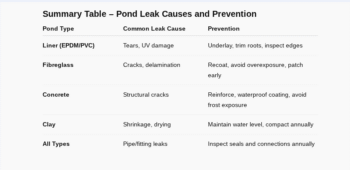
Summary Table – Pond Leak Causes and Prevention
🚿 When to Call a Professional
If you’ve topped up your pond more than once a week or see damp patches around the edges, it’s time to get it assessed.
Our team uses non-invasive leak detection and offers long-lasting repair solutions for all pond types — liners, fibreglass, concrete, and clay.
👉 Book your pond inspection or call Sasaquatics today for local, eco-conscious repair services across Devon & Cornwall 08000371125
What is the best pond liner for Devon’s weather?
EPDM or butyl liners perform best; they flex with temperature and resist UV better than PVC.
Can a concrete pond be resealed without rebuilding?
Yes — fibreglass overlays or waterproof renders can restore integrity for decades.
Do clay ponds hold water naturally?
Only if the clay is dense and compacted. In drier Devon summers, for home ponds they may need liner reinforcement.
How do I know if my pond has a leak or just evaporation?
In Devon’s climate, natural evaporation usually lowers pond levels by 1–2 cm per week in summer.
If your pond drops faster — especially overnight — or damp ground appears near the edges, you likely have a leak.
Can a pond leak underground without visible signs?
Yes. Water can travel under liners or through porous clay, escaping far from the original leak.
A professional leak test traces water movement and pinpoints the exact source using pressure and dye tests.
How long should a pond liner last?
A quality EPDM or butyl liner lasts 20–40 years if installed correctly with an underlay.
PVC liners typically last 10–15 years and are more vulnerable to UV and root damage.
Can I repair a pond liner underwater?
Small punctures can be patched underwater with specialist EPDM repair tape or liquid sealant, but for lasting repairs, it’s best to partially drain the pond and clean the surface first and this is what we would recommend.
What’s the best way to seal a concrete pond?
For concrete ponds, use a flexible pond-safe waterproof render or add a fibreglass overlay.
Avoid standard building sealants — they can release chemicals harmful to fish and wildlife.
Are fibreglass ponds better than liners?
Fibreglass ponds offer durability and clean edges, but they’re more expensive to install and can crack with ground movement.
Liners are easier to repair and ideal for wildlife or irregular shapes.
Can clay ponds be repaired naturally?
Yes. Clay ponds can often be restored by compacting damp clay or adding sodium bentonite, a natural sealing clay.
In drier regions or exposed sites, a hybrid clay + liner system offers the best longevity.
Why do pond edges leak after heavy rain?
Devon’s rain can cause soil to settle or roots to lift edges, letting water escape over low spots.
Check edging stones or turf regularly and reset any that have shifted.
How can I prevent leaks during winter?
Keep water levels stable and avoid allowing ice to expand in rigid ponds.
For fibreglass and concrete ponds, maintain partial circulation to prevent frost cracks.
Trim back vegetation that could root under liners.
Do you repair wildlife ponds as well as ornamental ones?
Yes. We work on wildlife, ornamental, and natural swimming ponds across Devon and Cornwall, using eco-safe materials that protect amphibians and invertebrates.
Can you combine clay and liner systems?
Absolutely. We often line clay ponds with a protective EPDM membrane and cover it with a layer of local clay — blending natural appearance with leak prevention.
Do you cover both Devon and Cornwall?
Yes. Our repair and maintenance services cover all of Devon and Cornwall, including Exeter, Plymouth, Totnes, Truro, Bodmin, and surrounding areas.
How do I book an inspection?
You can book a pond inspection
through our contact page or call our local team. Pictures would be great and these and either be sent by whatsapp or email.