
Do You Need Planning Permission for a Wildlife Pond in Devon and Cornwall?
Why a wildlife pond matters
Wildlife ponds are one of the most effective, cost-effective ways to boost biodiversity on your land. Whether you’re a private landowner, farmer, or community group, a well-designed pond can attract amphibians, invertebrates, dragonflies, birds, and create stepping stones in the landscape for nature. In regions like Devon and Cornwall—where many ponds have been lost over the past century—creating new waterbodies is a powerful rewilding tool.
At SAS Aquatics we specialise in pond and wetland creation, restoration and management across Devon & Cornwall, aligning ecological gains with landowner interests. One of the first questions we hear is: “Do I need planning permission?” Let’s dive into the answer.
The short answer: usually not—but check the details
For most small garden wildlife ponds, ornamental ponds or modest new waterbodies, planning permission is not required—as long as they fall within permitted development rights and are outside protected zones. For example, the Freshwater Habitats Trust states:
“Garden ponds do not usually require planning permission. However, it is worth checking this with your local authority.”
But—and this is important—there are significant caveats when you step into more complex or large-scale pond creation. These include size, location, hydrology, protected designations, connectivity to watercourses, flood risk and spoil disposal. See below for key triggers.
Planning a pond on agricultural land?
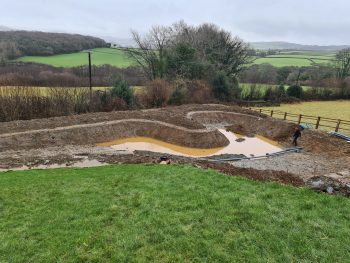
There is no single pond size that guarantees permission is or is not required. The purpose of the pond, scale of the earthworks, location, hydrology, flood risk, designations and treatment of excavated material all matter. A site-specific check before excavation is safer than relying on a general size rule.


When you might need planning permission (or other consents)
Here are common circumstances where additional permissions may apply:
- Location in a protected landscape: If your land lies within an Area of Outstanding Natural Beauty (AONB), National Park, or has SSSI/SAC/SPA status, extra restrictions apply.
- Large engineering works: If you’re creating a pond of several hectares, building dams, altering watercourses, or excavating large volumes of spoil, the work may count as “engineering operations” under planning law.
- Connection to watercourse or floodplain issues: The Environment Agency may require an environmental permit if your pond works affect a main river, flood/sea defence or are in a flood-risk zone.
- Spoil removal and disposal: If you excavate and remove large volumes of material off site, or affect topsoil, you may need waste-legislation consents and check with local authority.
- Protected species habitat: If the site is used by, or could affect, protected species (for example the Great Crested Newt), you may need ecological surveys and licensing even if planning consent is not formally required.
Specific to Devon & Cornwall: what you should do
As you’re working within Devon & Cornwall (or near by), here are local considerations:
- Consult the MAGIC map (DEFRA’s interactive map) to check for designations (SSSI, SINC, etc) and watercourse or floodplain overlays.
- Review the relevant planning authority’s guidance (e.g., Devon County Council and district/borough councils) on “Wildlife and geology planning guidance”.
- If you’re working on farmland and intend to use grant regimes (e.g., ELMS, Countryside Stewardship) check those scheme requirements too (they may require you to demonstrate no planning breaches).
- Ensure you respect natural hydrology and buffer zones—especially in Dartmoor, Exmoor fringes or coastal Cornwall where water bodies may have sensitivities
Step-by-step: What we recommend at SAS Aquatics
Here’s how we guide clients through the process:
Pre-site assessment: We check mapping (MAGIC), identify flood zones, protected sites, watercourses, existing ecology and hydrology.
Check permitted development: For modest pond works, establish whether the proposed works lie within PD rights (e.g., small garden pond, no major engineering).
Identify triggers for consents: Determine if you need planning application, environmental permit, waste transfer note, or ecological surveys.
Design with compliance in mind: Shape the pond to avoid issues (e.g., keep away from main river, avoid large spoil removal, design depths, margins for wildlife).
Engage early with authorities: If in doubt, submit a “pre-application” to the local planning authority to check whether permission is required.
Document for grants: If you’re seeking funding, keep records of site assessment, ecology checks, design documents and permissions.
Implementation and monitoring: Once works are done, ensure habitat creation, planting and monitoring of biodiversity follow best-practice.
Why engaging professionals matters
For landowners considering a wildlife pond, partnering with a specialist like SAS Aquatics offers value beyond simply “digging a hole”. We bring:
- Ecological expertise (habitat design, species requirements, low-impact construction)
- Regulatory knowledge (planning triggers, environmental permits, waste handling)
- End-to-end service: from site assessment → design → funding advice → build → monitoring
- Local experience in Devon & Cornwall’s unique landscapes (moorland fringes, coastal sites, farmland)
Final takeaway
In most garden and modest wildlife pond projects across Devon & Cornwall you won’t need full planning permission, but you must check for triggers—including location, size, flood risk, species, and hydrology. Taking the time upfront to assess these factors ensures your pond delivers ecological benefit, avoids legal headaches and aligns with funding opportunities.
If you would like help assessing your site, explore our planning, grants and environmental support and wildlife pond services, explore wetland creation in Devon and Cornwall, or send us your site details. We can support you from the first feasibility check through to a thriving habitat.
If I build a pond myself with a digger, does that automatically need planning?
Not always—but large excavations may count as engineering works and trigger permission. Always check with the local authority.
If my land is in the floodplain, what then?
If your pond affects a flood zone or connects to a main river/flood defence, an environmental permit may be required from the Environment Agency.
Does keeping fish change anything?
Yes. A pond intended for fish or as a fishing lake often falls under different rules (e.g., agriculture/fisheries) compared with a pure wildlife pond. The latter has more flexibility.
Can I just proceed if planning seems not required?
You can—but do so with caution. Keep records, consider surveys, check for protected species, and be prepared to show you’ve acted responsibly. If the site later turns out to need consent, you risk enforcement action.